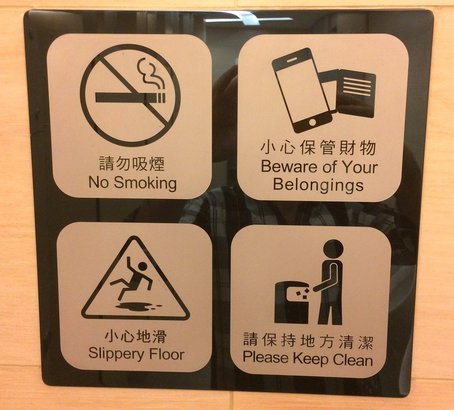
 Signs like this one, reminding readers to 'beware of your belongings', are quite common in Hong Kong. Their purpose is to warn us of the risk of loss or theft, so that we pay more attention to the valuables that we are carrying with us. In Hong Kong, 'beware' is often the generic term used to provide this warning. However, in standard English the word 'beware' has a much more specific meaning and usage. Here is the Oxford online dictionary definition: 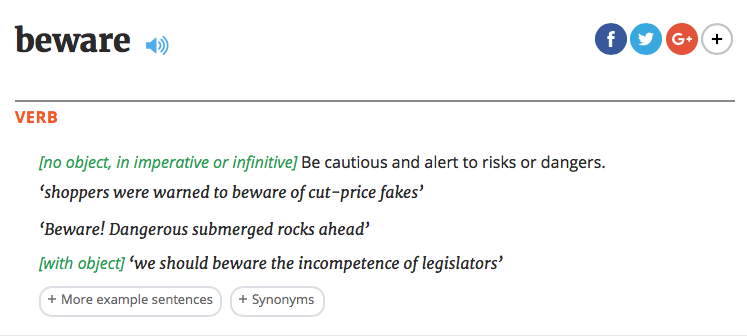 At first sight, this definition may seem to fit our HK sign -- after all, isn't the sign warning people to 'be cautious and alert to risks or dangers'? However, the important thing to note here is that 'beware' is generally always followed by the preposition 'of' plus a description of the source of the risks or dangers being referred to. In the expression 'beware of your belongings', the words 'your belongings' should thus identify the source of the risk. Logically speaking, however, it is NOT our belongings that are the source of risk or danger. The risk here is of thieves, or possibly there is a risk of you being forgetful and not remembering to take your belongings with you when you leave. If we are worried about theft, the correct warning is as follows: 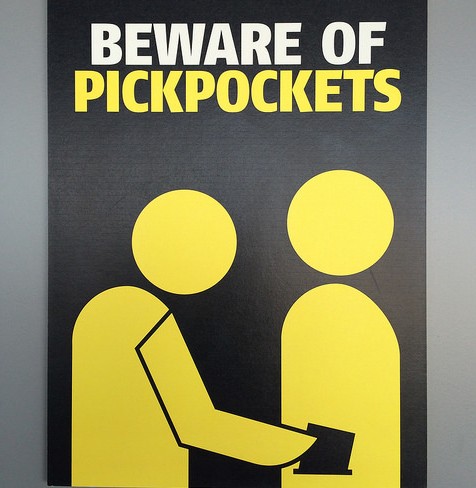 What seems to have happened in HK is that writers have confused the differences between two similar but actually quite different expressions:
Here is an example of how the expression 'be aware of' is commonly used: 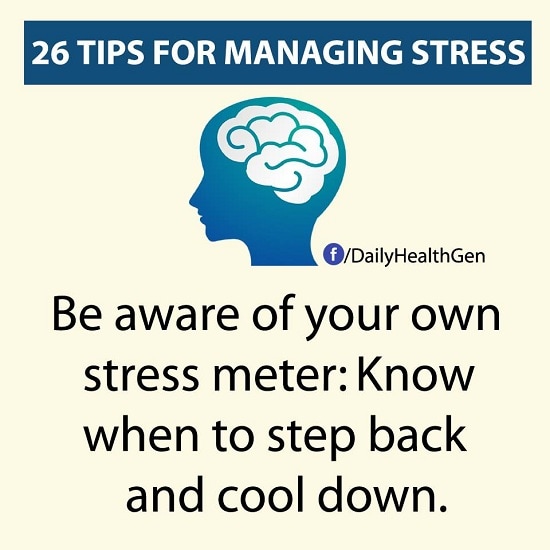 Here, 'be aware of' has a completely different meaning from 'beware of' -- it means 'think about, pay attention to'. Normally, 'be aware of' is followed by a noun phrase that describes a situation rather than a thing, e.g. 'be aware of your own stress meter, be aware of your surroundings, be aware of your ...' When we want to warn people to focus their attention on specific things or objects (like their belongings, for example), we don't normally use 'be aware of'. Instead, you will find expressions like:
… used correctly in the Hong Kong sign below! 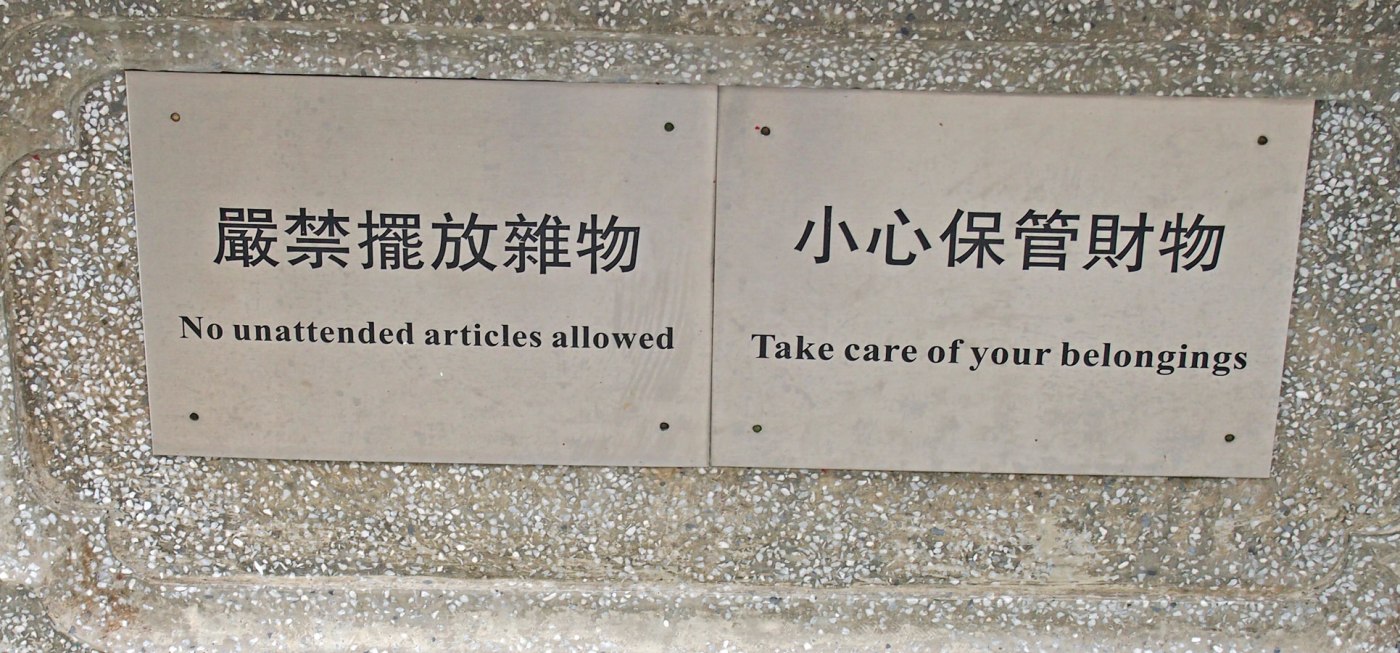
3 Comments
Flygplatsen
1/9/2017 10:41:56 pm
Really interesting blog you have here, you've landed yourself a subscriber! I also have my eyes peeled whenever I'm out and about in Hong Kong and the use of English here sometimes drives me nuts! Another example to add to the arsenal, the "Keep in lane" sign on highways and in tunnels. I assume they mean "no lane changing" or "stay in your lane". "Keep left", yes, but "keep in lane" just sounds wrong.
Simon
3/9/2017 04:50:18 am
Thanks for your input. I have been thinking about your comments on 'keep in lane' and your feeling that 'stay in lane' would be more natural English, and I'm not sure that 'keep in lane' is quite as unusual as you think. Here is a sentence from the New Zealand Transport Agency guidelines: "Where there are two or more lanes on your side of the centre line, keep in the left-hand lane as much as you can". I also note that some new cars nowadays are fitted with so-called 'Lane keeping systems' (see e.g. https://owner.ford.com/how-tos/vehicle-features/safety/lane-keeping-system.html) -- not 'lane staying systems'. This makes me think that some further work needs to be done on the precise differences between 'stay' and 'keep' to work out why 'stay in lane' tends to be more widely used than 'keep in lane'.
Simon
3/9/2017 04:56:29 am
Some of the relevant HK legislation governing the traffic sign 'Keep in lane' can be viewed at https://www.elegislation.gov.hk/hk/cap368A (see figure 5) -- I note that this legislation was drafted in 1982, long before the British handed Hong Kong back to China! Almost certainly the key bureaucrats in the Transport Department at that time were expat Brits, and this kind of signage would need to have been approved by them. Your comment will be posted after it is approved.
Leave a Reply. |

About this blogThis blog arises from keeping an eye on English in Hong Kong. I often use signs, notices and advertisements that I see as starting points to write about English issues that commonly challenge Hong Kong writers. Archives
October 2017
Categories
All
|
 RSS Feed